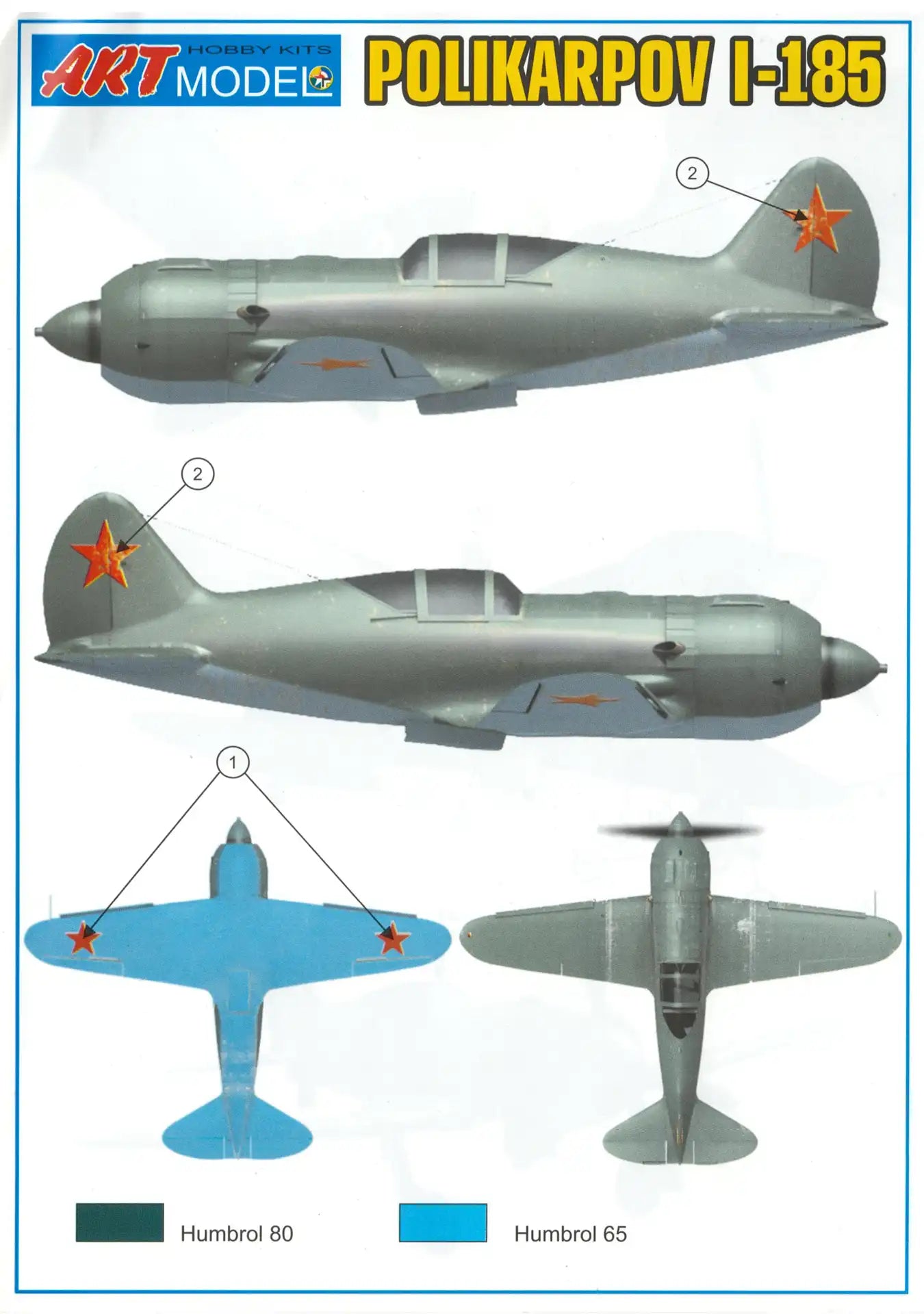
Art Model AM 7206 Polikarpov I-185 WWII Soviet Fighter


Polikarpov I-185 WWII Soviet Fighter
Conceived in early 1940 by the Polikarpov Design Bureau, the I-185 was engineered around a consistent, highly loaded all-metal wing structure with a planform area of 167.16 sq ft. While this core aerodynamic geometry remained intact throughout the development cycle, the aircraft underwent significant airframe and powerplant revisions across successive prototypes, accommodating different radial installations, adjusted fuselage lengths, armament suites, and structural refinements.
In the spring of 1942, Polikarpov rolled out the "etalon" (definitive production standard) airframe, powered by the Shvetsov M-71 twin-row radial engine and armed with three synchronized 20 mm cannons. Taking to the air on its maiden flight on June 10, 1942, the fighter concluded manufacturer trials that October, followed by State Acceptance Trials at the NII VVS between November 1942 and January 1943. Concurrently, between December 9, 1942, and January 12, 1943, experimental prototypes proved their mettle in operational combat trials on the Kalinin Front.
The evaluation reports were glowing: Soviet test pilots concluded that the I-185 outright outperformed every frontline Allied and Axis fighter in service in 1942. Despite a high wing loading of 49.15 lb/sq ft, the fighter exhibited forgiving handling characteristics, making it well-suited for average squadron aviators. The aircraft clocked 423 mph at 20,013 ft (and 373 mph at sea level under war emergency power), while demonstrating an exceptional initial climb rate of 3,937 ft/min alongside formidable maneuverability and payload capacity.
Despite an official recommendation for immediate series production in November 1942, the promising fighter ran straight into wartime industrial realities. The program was hindered by critical nationwide shortages of aviation-grade duralumin, a lack of available factory floor space, and ongoing developmental bottlenecks with the unproven M-71 engine. Production priorities favored the all-wood Lavochkin La-5, which was already rolling off existing LaGG-3 assembly lines without draining aluminum stockpiles; furthermore, immense demand for the proven M-82 radial to supply active assembly lines severely undercut any prospect of producing an M-82-powered I-185 variant.
The final blow landed on April 5, 1943. During preparations for long-range endurance trials, the second prototype (No. 6202) suffered an abrupt engine failure traced to a clogged carburetor main jet. The resulting crash claimed the life of veteran test pilot Vasily Stepanchenok. Thwarted by supply-chain bottlenecks and political headwinds, Polikarpov’s masterpiece never recovered, leaving what could have been the Red Army's finest piston fighter out of series production.
Technical Specifications of the Polikarpov I-185 (M-71 Production Standard)
- Year of production — 1942
- Length — 26.41 ft
- Wingspan — 32.15 ft
- Wing area — 167.16 sq ft
- Powerplant — 1 × Shvetsov M-71 radial engine, 1,625 hp normal / 2,000 hp takeoff
- Maximum speed — 423 mph
- Landing speed — 93 mph
- Armament — 3 × 20 mm ShVAK cannons, 4 × 220 lb bombs (up to 1,102 lb in overload condition)
Marking Options:
-
Polikarpov I-185 M-71 “Etalon”, Capt. Nikolay Ignatyev, operational trials, 728th IAP, Kalinin Front, December 9, 1942 – January 12, 1943


- Product type:
- Scale Model Kit
- Condition:
- New
- Scale:
- 1/72
- Manufacturer:
- Art Model
- Product code:
- AM 7206
- Country of Origin:
- Ukraine
- Kit Type:
- Multimedia
- Dimensions:
- 14 × 12 cm
- Package Contents:
- Plastic parts, clear parts, resin parts, decals, assembly guide, box
- Parts Count:
- 36 pieces
- Marking Options:
- 1
- Operator Nations:
- USSR
- Era:
- World War II (1939–1945), Eastern Front (1941–1945)
- Skill Level:
- 4/5 Proficient