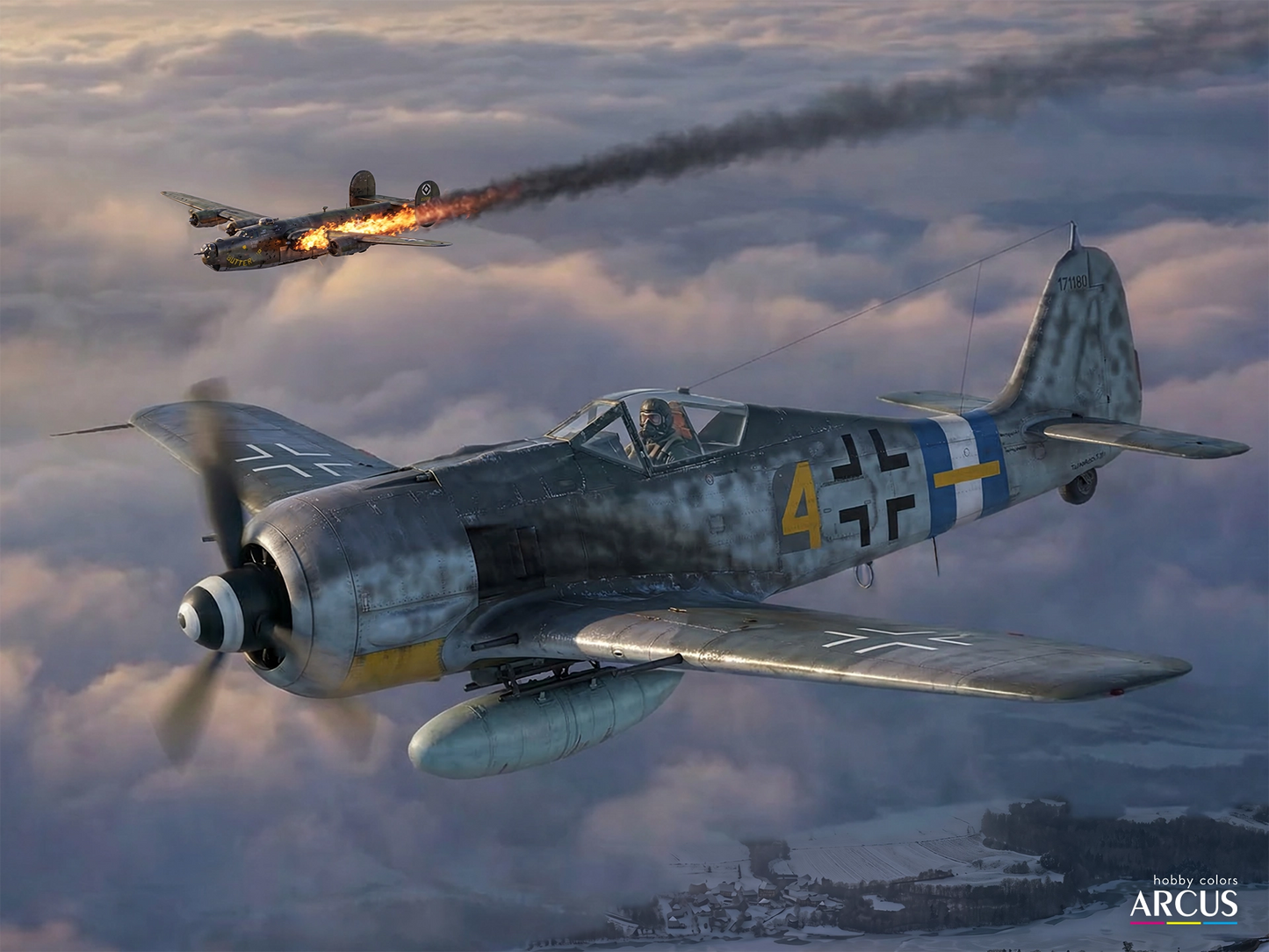
Arcus E2019 Luftwaffe: Defense of the Reich


Luftwaffe: Defense of the Reich
After the sweeping successes of the early war years, the German offensive ground to a halt. The defeat in the Battle of Britain, the deployment of U.S. strategic aviation to the British Isles, and the onset of American bombing campaigns in January 1943 forced the Luftwaffe to focus entirely on defending its own airspace. Daylight raids grew increasingly frequent, ultimately escalating into massive operations. The largest of these occurred on December 24, 1944. To cripple German logistics during the Battle of the Bulge, the U.S. Eighth Air Force dispatched 2,034 B-17 and B-24 heavy bombers, escorted by nearly a thousand fighters. The air war had definitively shifted to the skies over the Reich.
When intercepting such massive armadas, with entire fighter wings scrambling simultaneously, pilots found it exceedingly difficult to regroup their squadrons following an attack. The aviators of JG 1 were among the first to address this problem, introducing brightly colored checkered and striped engine cowlings on their Fw 190s. However, this initiative was swiftly abandoned. Certain units flying the visually similar American P-47 Thunderbolt—operating on escort missions from bases in southern Italy, newly liberated from Fascist Italian and Wehrmacht forces—also sported checkered cowlings. A subsequent attempt to paint vertical stabilizers solid white also proved ineffective due to the rapidly growing number of Reich Defense units.
As an alternative, broad colored bands were applied to the aircraft fuselages. Yet, lacking a centralized system, individual wings selected colors at their own discretion, showing a strong preference for red or brownish-red shades. Rather than easing identification, this created even greater confusion, making it virtually impossible to visually distinguish a plane's unit mid-flight. A strict system of fuselage bands was not introduced until late 1944, officially assigning each wing a unique color or a specific stripe sequence. The historical irony was that the moment these markings were finally standardized, they were effectively abandoned—amid the chaos of the war's final months, such identification elements were frequently omitted from newly produced aircraft.
Suggested kits:
Focke-Wulf Fw 190 Würger, Focke-Wulf Ta 152, Messerschmitt Bf 109, Messerschmitt Bf 110, Messerschmitt Me 210, Messerschmitt Me 262 Schwalbe, Messerschmitt Me 410 Hornisse, etc.
- Product type:
- Paint Set
- Condition:
- New
- Manufacturer:
- Arcus
- Product code:
- E2019, A2019
- Country of Origin:
- Ukraine
- Volume:
- 6 × 0.33 fl oz (10 mL)
- Finish:
- Semigloss
- Paint Type:
- Enamel, acrylic
- Package Contents:
- Paint bottles (6 pcs.), box
- Operator Nations:
- Germany
- Era:
- World War II (1939–1945)