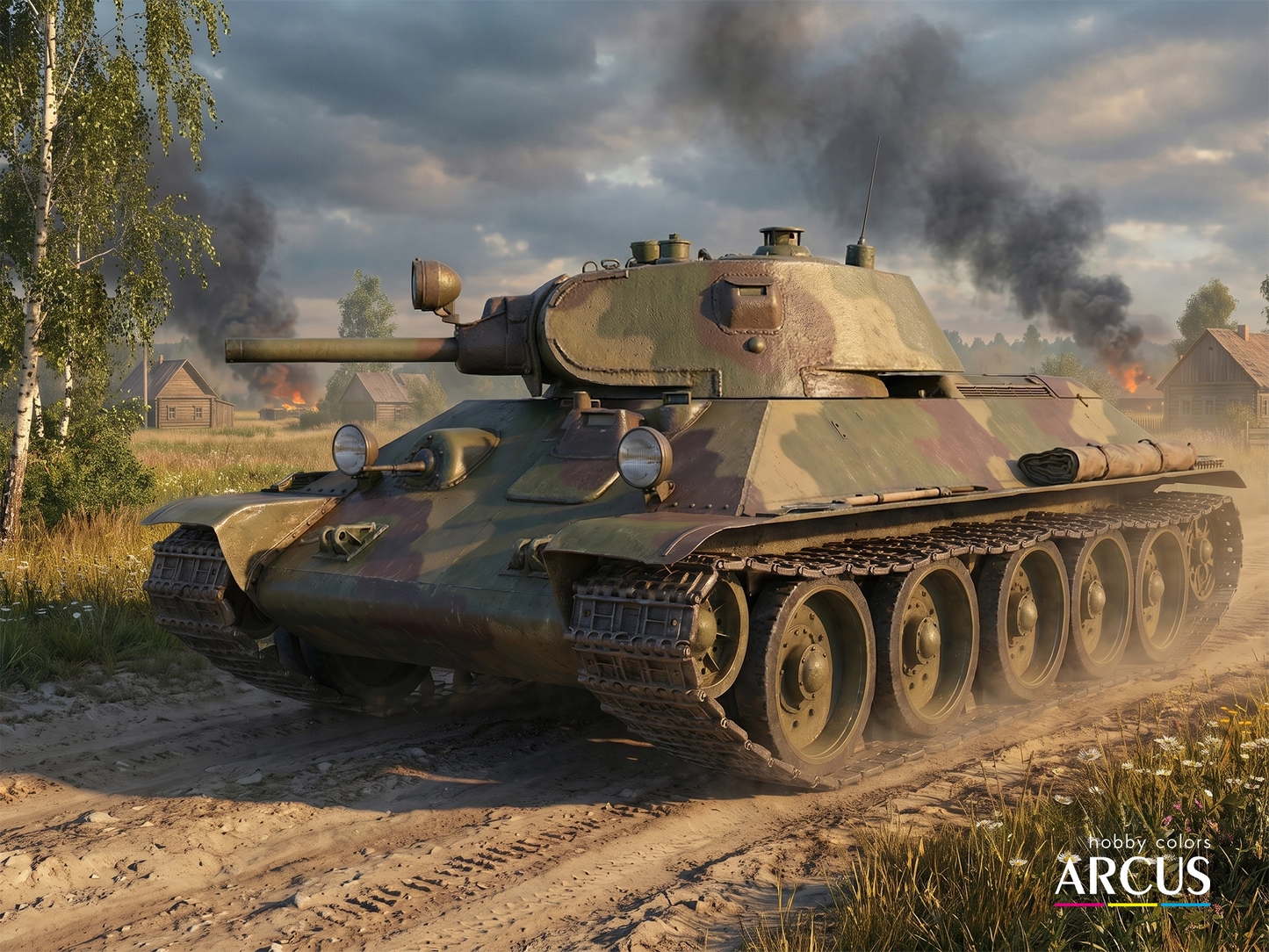
Arcus E1099 RKKA: Battle of Leningrad


RKKA: Battle of Leningrad
On July 10, 1941, just eighteen days into the invasion, the vanguard of the Wehrmacht had surged over 300 miles across the Baltic states from the borders of East Prussia, reaching the outer approaches to Leningrad. German mechanized columns were driving deep into Soviet territory at an average rate of nearly 20 miles a day, closing in on the USSR's second most important city, after Moscow—the cradle of the Bolshevik Revolution and the birthplace of the Soviet state. By early September, Leningrad was completely cut off by land. Hitler was so confident of an imminent triumph that he even had invitations printed for a victory banquet at the Hotel Astoria. However, once German forces reached the city's outskirts, the High Command altered its strategy: General Erich Hoepner’s 4th Panzer Group, which had served as the primary armored spearhead of the offensive, was withdrawn and redirected to the Moscow axis.
Deprived of Hoepner’s armored thrust, the Wehrmacht's advance stalled at the Soviet defensive lines, forcing a shift in strategy from a direct assault to a prolonged siege. For the city's residents, this marked the beginning of a catastrophic 872-day ordeal that lasted until January 1944. With all available resources strictly prioritized for the front lines and munitions factories, the civilian population was left virtually without food. The suffocating encirclement triggered a devastating famine, leading to the deaths of hundreds of thousands and documented instances of cannibalism.
The transition to positional warfare compelled the Soviet command to abandon its offensive doctrine. Now forced into a defensive posture, where standard solid-colored tanks presented overly easy targets, the military reverted to camouflage schemes approved by the NIIBT (Scientific Research Institute of Armored Equipment) back in August 1939. Under these pre-war regulations, vehicles assigned to the Leningrad Military District were slated for large-pattern disruptive camouflage designed specifically to break up a vehicle’s silhouette in static positions.
At the time, Soviet industry had only managed to mass-produce three basic pigment shades in the form of thick pastes: 4BO protective green, 6K dark brown, and 7K yellow-earth. In field maintenance shops, crews thinned these pastes using drying oil mixed in equal parts with either gasoline or kerosene. Roughly half of a vehicle’s surface area was left in the standard 4BO (as tanks were delivered from the factories painted entirely in this solid overall finish), while the remainder was covered with large, asymmetrical patches of 6K and 7K, each accounting for about 25 percent of the overall pattern. The light T-37 and T-38 tanks generally featured a tightly mottled camouflage pattern of 6K or 6RP applied over the 4BO base coat.
Once winter set in, crews applied a standard lime whitewash over the existing camouflage to blend in with the snow-covered terrain. This expedient measure was eventually replaced by "White B," a specialized, easily washable winter paint.
Suggested kits:
BA-3, BA-6, BA-10, BA-20, FAI, BT-5, BT-7, KV-1, KV-2, T-26, T-28, T-34, T-37A, T-38, T-50, T-60, T-20 “Komsomolets”, GAZ-AA, GAZ-AAA, GAZ-MM, GAZ-M1 "Emka", GAZ-61, GAZ-64, ZiS-5, ZiS-6, YaG-6, M-72, TIZ-AM-600, L-8, IZh-9, BM-13 "Katyusha", 37 mm Automatic Anti-Aircraft Gun M1939 (61-K), 76 mm Anti-Aircraft Gun M1931 (3-K), 85 mm Anti-Aircraft Gun M1939 (52-K), 45 mm Anti-Tank Gun M1937 (53-K), 76 mm Regimental Gun M1927, 76 mm Divisional Gun M1936 (F-22), 76 mm Divisional Gun M1939 (USV), 76 mm Divisional Gun M1942 (ZiS-3), 122 mm Howitzer M1938 (M-30), 152 mm Howitzer-Gun M1937 (ML-20), 122 mm Gun M1931/37 (A-19), etc.
- Product type:
- Paint Set
- Condition:
- New
- Manufacturer:
- Arcus
- Product code:
- E1099, A1099
- Country of Origin:
- Ukraine
- Volume:
- 6 × 0.33 fl oz (10 mL)
- Finish:
- Semigloss
- Paint Type:
- Enamel, acrylic
- Package Contents:
- Paint bottles (6 pcs.), box
- Operator Nations:
- USSR
- Era:
- Interwar (1918–1939), World War II (1939–1945)