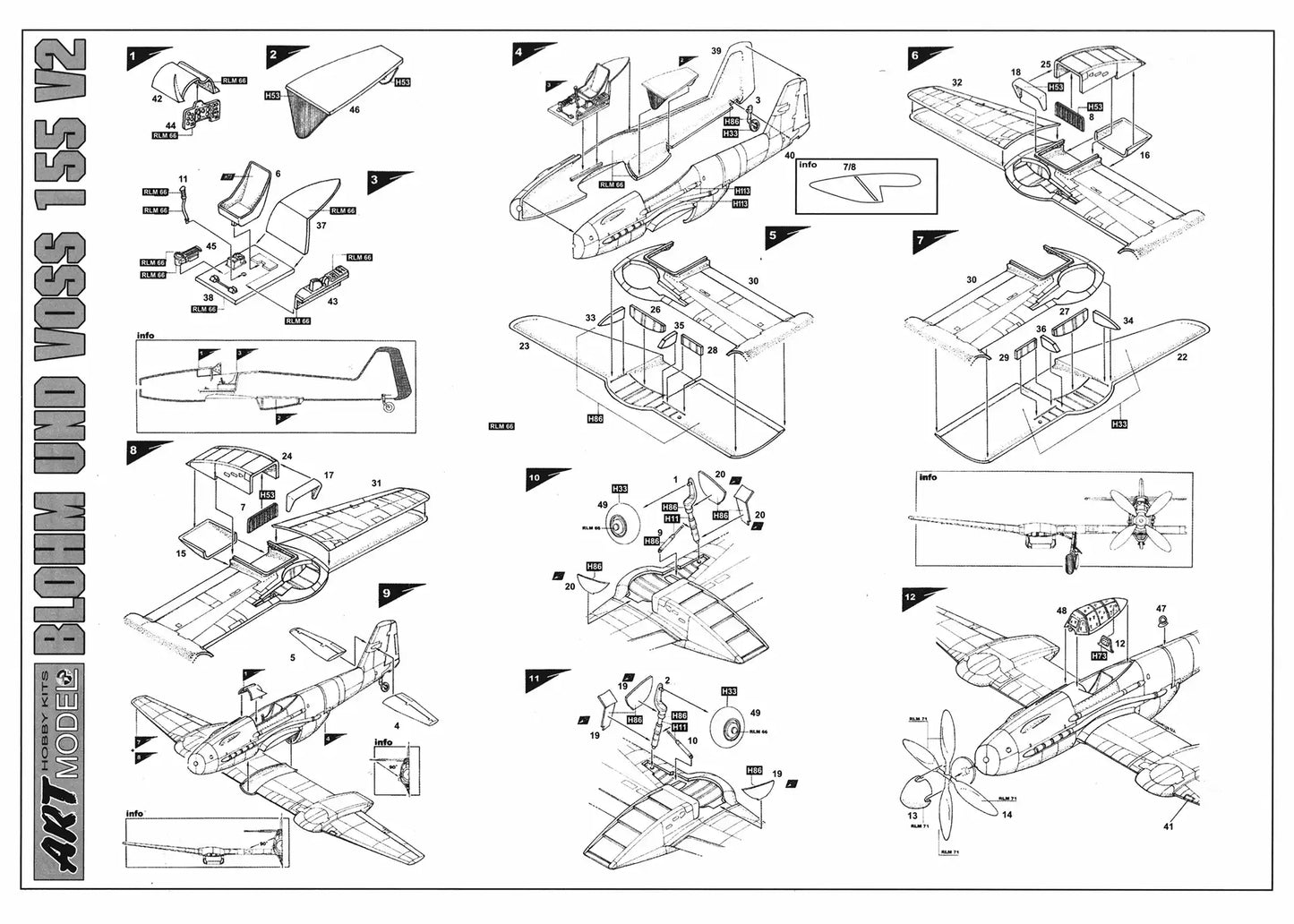
Art Model AM 7202 Blohm & Voss BV 155 V1 WWII German High-Altitude Interceptor


Blohm & Voss BV 155 V1 WWII German High-Altitude Interceptor
Among the highly unconventional piston-engine fighters developed in the Third Reich during the Second World War was the Blohm und Voss BV 155, a cumbersome high-altitude interceptor. Development began in 1942 when Messerschmitt initiated work on the Me 155. Originally, the aircraft was intended as a shipborne interceptor for the proposed German aircraft carrier Graf Zeppelin, which ultimately never entered service. The design relied heavily on Bf 109 components and featured navalized equipment, including folding wings, catapult fittings, and arrester gear. The project was temporarily shelved when work on the Graf Zeppelin was halted. Messerschmitt subsequently redesigned the Me 155 to meet a Luftwaffe requirement for a fast, single-seat bomber capable of carrying a 2,205 lb SC 1000 bomb. This required the removal of naval fittings and the installation of an elongated tailwheel strut to provide ground clearance for the payload. The design parameters were later altered again, shifting the focus to a high-altitude interceptor role. In August 1943, following protracted disputes between the Messerschmitt and Blohm und Voss design teams, the Luftwaffe's Technical Department officially removed Messerschmitt from the project, transferring sole developmental responsibility to Blohm und Voss under Chief Designer Richard Vogt.
Designated BV 155 V1, the first prototype made its maiden flight on September 1, 1944. Power was provided by a turbocharged DB 603A engine generating 1,450 hp at an altitude of 49,213 ft, driving a four-bladed wooden propeller with a diameter of 12.8 ft. The onboard equipment included an MW-50 power-boosting system, an Rb 50/30 camera positioned aft of the pilot's seat, and FuG 16ZY (equipped with direction-finding and ranging functions) alongside FuG 25a radio sets. Standard internal fuel capacity was 158 US gallons, while the addition of an integral spar tank increased the total capacity to 317 US gallons. The pressurized cockpit, constructed from welded steel plates, served as the structural mounting point for the engine and the turbocharger. A cabin pressure altitude equivalent to 24,606 ft was continuously maintained up to the aircraft's service ceiling by the engine-driven supercharger, which operated in conjunction with a dedicated fan.
The second prototype, the BV 155 V2, commenced testing on February 8, 1945. Because the V1 experienced critical engine overheating during takeoffs, the radiators on the V2 were relocated to the wings and mounted at a high angle of incidence. Furthermore, it became evident that the total radiator area required enlargement. The initial reluctance to mount the radiators on the wings stemmed from concerns that the landing gear struts might blanket the airflow during the critical takeoff phase. However, wind tunnel testing demonstrated that airflow separation within the radiator posed no danger once the main landing gear retraction cylinder was removed. These modifications were integrated into the V2, which served as the prototype for the B-series. Nevertheless, Vogt and his team remained dissatisfied with the basic configuration. Consequently, a revised variant, designated Projekt 205, was proposed to the Technical Department. This modernization required the installation of a DB 603U engine, paired with a mechanical supercharger from the DB 603E utilizing a 2.07:1 reduction gear, while retaining the TKL-15 turbocharger. A more compact liquid cooling system, modeled after the Ta 152 design, was implemented. Two large air intakes were positioned aft of the wing trailing edge. The starboard intake was dedicated to the turbocharger, whereas the port intake supplied air to a heat exchanger, with the exhaust air venting through a slot behind the starboard intake. Downstream of the compressor, the air was routed through an intercooler situated within the lower radiator before entering the induction manifold. The fuselage and cockpit remained largely unmodified, as did the horizontal tail surfaces, although the stabilizer bracing struts were eliminated. The vertical fin was enlarged and redesigned.
Production schedules mandated the completion of the BV 155 C-01 (V4) pre-production aircraft in April 1945, the C-02 in May, and the C-03 and C-04 variants in June. However, assembly operations ceased abruptly when Allied forces captured the Blohm und Voss facility at Finkenwerder in April 1945. The unfinished third prototype was subsequently transported to the United Kingdom for preliminary evaluation by the Royal Aircraft Establishment at Farnborough. The airframe was later shipped to the United States for comprehensive technical analysis and is currently preserved at the Smithsonian Institution in Maryland, United States.
Technical Specifications of the Blohm und Voss BV 155
- Length — 39.37 ft
- Wingspan — 67.26 ft
- Height — 9.78 ft
- Maximum speed — 429 mph
- Operational range — 895 miles
- Service ceiling — 55,774 ft
Marking Options:
-
Blohm & Voss BV 155 V1, W.Nr. 360051, Finkenwerder factory airfield, late 1944


- Product type:
- Scale Model Kit
- Condition:
- New
- Scale:
- 1/72
- Manufacturer:
- Art Model
- Product code:
- AM 7202
- Country of Origin:
- Ukraine
- Kit Type:
- Multimedia
- Dimensions:
- 29 × 17 × 5 cm
- Package Contents:
- Plastic parts, clear parts, resin parts, decals, assembly guide, color leaflet, box
- Parts Count:
- 51 pieces
- Marking Options:
- 1
- Operator Nations:
- Germany
- Era:
- World War II (1939–1945)
- Skill Level:
- 4/5 Proficient