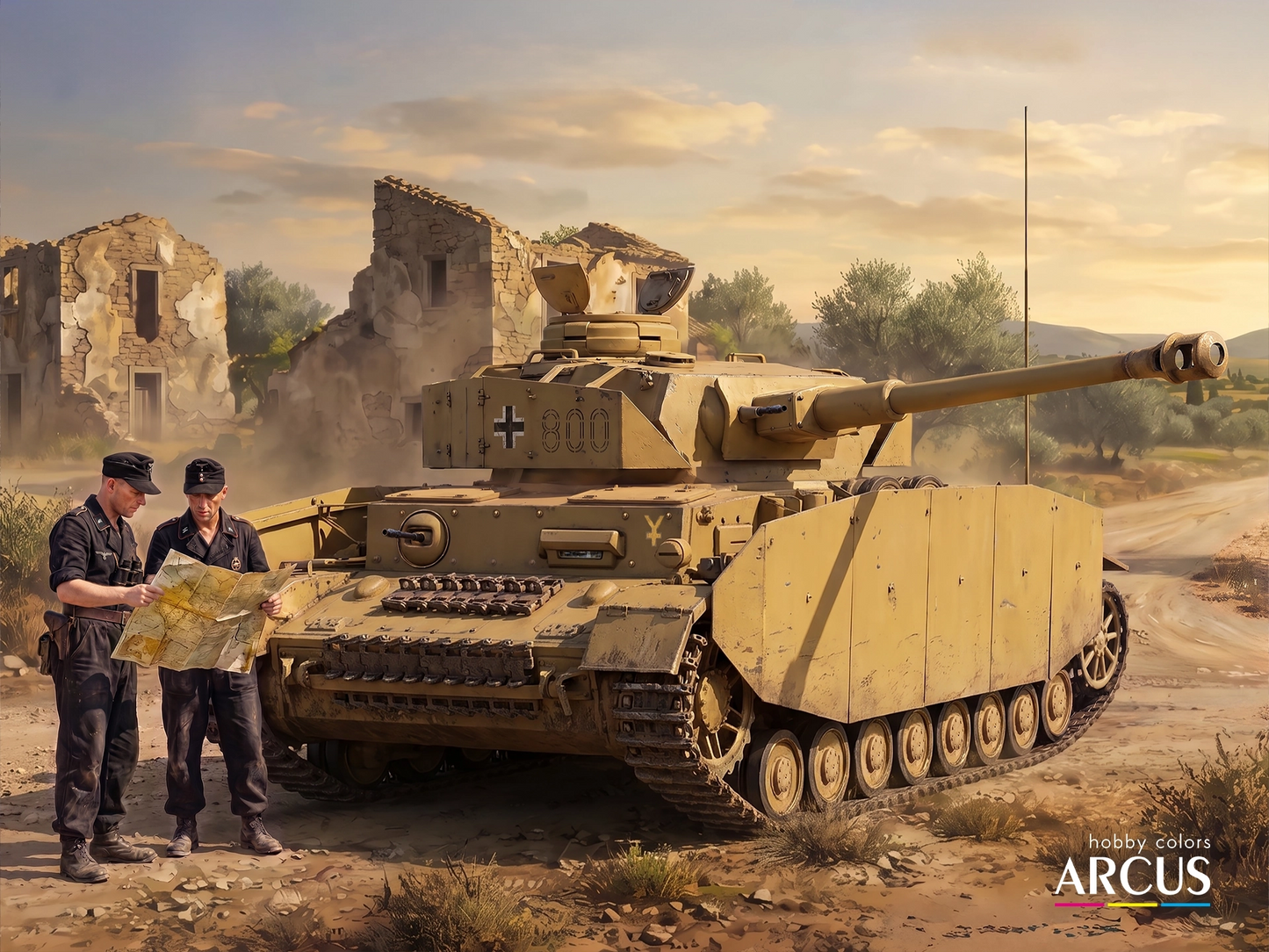
Arcus E2094 Wehrmacht: Operation Achse


Wehrmacht: Operation Achse
When Benito Mussolini was deposed in the summer of 1943, Berlin harbored no illusions regarding the new Italian government: its pledges of continued loyalty were recognized immediately as a delaying tactic. The German High Command had already prepared for its ally's defection. The moment Rome’s capitulation was announced, the Wehrmacht executed Operation Achse. Originally codenamed Alarich—an explicit nod to the Visigoth king who sacked Rome in AD 410—the operation had been redesignated with the neutral title Achse (Axis) for operational security. Berlin cynically framed the mass disarmament of its former partner as a necessary step to maintain coalition stability.
The Italian armed forces found themselves completely paralyzed. Following the flight of the king and the high command from the capital, a massive command vacuum emerged. Field units received conflicting orders, or often none at all. Fierce but isolated engagements erupted only where local commanders took the initiative—most notably on the approaches to Rome—but the vast majority of garrisons surrendered without a fight. Within a matter of days, German forces had disarmed and interned over a million Italian troops, rapidly consolidating control over northern and central Italy.
Wherever armed resistance was anticipated, the Germans relied on overwhelming shows of force to preempt costly urban combat. Heavy armored columns were deliberately routed through major city centers. The 1st SS Panzer Division Leibstandarte advanced past the Duomo in Milan, while combat elements of the 3rd Panzergrenadier Division secured positions around the Colosseum in Rome. Extensively documented by German propaganda units, these overt displays of armored might were intended to break the Italian will to resist before a single shot was fired.
By this stage of the conflict, under OKH order HM 1943 No. 181 issued on February 18, 1943, all German armor left the factories finished in a standard base coat of Dunkelgelb. The secondary camouflage colors—Olivgrün and Rotbraun—were issued to frontline troops as heavy pigment pastes. In the field, tank crews and maintenance echelons thinned these pastes with whatever solvents were readily available: gasoline, water, or even used motor oil. The paint was applied using compressors and spray guns, or simply daubed on with standard brushes when pneumatic equipment was lacking. Consequently, the camouflage schemes seen on German armor throughout the summer and autumn of 1943 exhibited immense variety, ranging from neatly sprayed, soft-edged bands and mottling to crude, heavy brushstrokes.
Suggested kits:
Pz.Kpfw. II Ausf. L "Luchs" (Sd.Kfz. 123), Pz.Kpfw. III (Sd.Kfz. 141), Pz.Kpfw. IV (Sd.Kfz. 161), Pz.Kpfw. V "Panther" (Sd.Kfz. 171), Pz.Kpfw. VI Ausf. E "Tiger I" (Sd.Kfz. 181), Pz.Kpfw. VI Ausf. B "Tiger II / Königstiger" (Sd.Kfz. 182), StuG III (Sd.Kfz. 142 / 142/1), StuG IV (Sd.Kfz. 167), Sturmpanzer IV "Brummbär" (Sd.Kfz. 166), Sturmmörser "Sturmtiger", Panzerjäger "Marder II" (Sd.Kfz. 131), Panzerjäger "Marder III" (Sd.Kfz. 138 / 139), Panzerjäger III/IV "Nashorn" (Sd.Kfz. 164), Jagdpanzer 38(t) "Hetzer" (Sd.Kfz. 138/2), Jagdpanzer IV (Sd.Kfz. 162), Jagdpanther (Sd.Kfz. 173), Jagdtiger (Sd.Kfz. 186), Panzerjäger Tiger (P) "Ferdinand / Elefant" (Sd.Kfz. 184), Geschützwagen II "Wespe" (Sd.Kfz. 124), Geschützwagen 38(t) "Grille" (Sd.Kfz. 138/1), Geschützwagen III/IV "Hummel" (Sd.Kfz. 165), Panzerwerfer 42 (Sd.Kfz. 4/1), Flakpanzer 38(t) (Sd.Kfz. 140), Flakpanzer IV "Möbelwagen" (Sd.Kfz. 161/3), Flakpanzer IV "Wirbelwind" (Sd.Kfz. 161/4), Flakpanzer IV "Ostwind" (Sd.Kfz. 161/3), Sd.Kfz. 221, Sd.Kfz. 222, Sd.Kfz. 231, Sd.Kfz. 232, Sd.Kfz. 234, Sd.Kfz. 247, Sd.Kfz. 250, Sd.Kfz. 251, Sd.Kfz. 2 "Kettenkrad", Sd.Kfz. 3 "Maultier", Sd.Kfz. 7, Sd.Kfz. 9 "FAMO", Sd.Kfz. 10, Sd.Kfz. 11, Raupenschlepper Ost (RSO), Bergepanther (Sd.Kfz. 179), Goliath (Sd.Kfz. 302 / 303), Borgward IV (Sd.Kfz. 301), BMW R75, Zündapp KS 750, VW Type 82 "Kübelwagen", VW Type 166 "Schwimmwagen", Horch 108, Steyr 1500, Leichter Funkkraftwagen (Kfz. 15), Mittlerer Funkkraftwagen (Kfz. 17), Opel Blitz, Ford V3000S, Mercedes-Benz L3000, 2 cm Flak 38, 3.7 cm Flak 37 / 43, 8.8 cm Flak 18 / 36 / 37, 7.5 cm Pak 40, 8.8 cm Pak 43 / 43/41, 10.5 cm leFH 18, 15 cm sFH 18, 15 cm Nebelwerfer 41, 21 cm Nebelwerfer 42, etc.
- Product type:
- Paint Set
- Condition:
- New
- Manufacturer:
- Arcus
- Product code:
- E2094, A2094
- Country of Origin:
- Ukraine
- Volume:
- 6 × 0.33 fl oz (10 mL)
- Finish:
- Semigloss
- Paint Type:
- Enamel, acrylic
- Package Contents:
- Paint bottles (6 pcs.), box
- Operator Nations:
- Germany
- Era:
- World War II (1939–1945)