Dragon 5010 Dornier Do 335B-6 “Pfeil” WWII German Night Fighter


Note: A really cool kit. Even though the tooling dates back to 1992, Dragon’s Do 335 was ahead of its time, and its level of detail can still rival many modern releases. Moreover, since 1992, no other manufacturer has attempted to tool a brand-new 1/72 “Pfeil.” The model is in good condition, with all parts preserved on the sprues. However, the decal has yellowed somewhat due to age and will require caution during application. The box has scuffs and storage marks.
Dornier Do 335B-6 “Pfeil” WWII German Night Fighter
The Dornier Do 335 stands as one of the most unorthodox combat aircraft developed during World War II, distinguished by its unique centerline push-pull powerplant layout. A forward engine drove a conventional tractor propeller in the nose, while a second engine, mounted in the center fuselage, drove a rear pusher propeller via an extended tubular driveshaft. By aligning both engines along the fuselage longitudinal axis, Dornier managed to double the available thrust while maintaining the sleek frontal area of a single-engine fighter. In the event of an engine failure, this configuration retained symmetrical thrust and completely eliminated asymmetric yaw. For safe emergency egress in flight, the aircraft was equipped with an ejection seat and a pyrotechnic system designed to simultaneously jettison the upper vertical fin, rudder, and rear propeller.
Claude Dornier patented the remote pusher-propeller drive in 1937, later proving the concept's mechanical and aerodynamic viability with the subscale Göppingen Gö 9 testbed in 1939–1940. Encouraged by these flight trials, the Dornier design bureau submitted the Projekt Do P.231 proposal to the Technical Office of the Reich Air Ministry (RLM) in May 1942, winning the single-seat high-speed bomber competition. The design received the official designation Do 335, but shifting operational requirements that autumn prompted the RLM to redirect the program toward a heavy fighter and fighter-bomber.
The initial prototype, Do 335 V1, made its maiden flight on October 26, 1943, piloted by test pilot Hans Dieterle. To facilitate operational and service trials, a pre-production batch of 10 Do 335 A-0 aircraft was completed in 1944, contributing to an overall tally of more than twenty development and pre-series airframes built by the war's end. Production subsequently transitioned to the definitive single-seat Do 335 A-1 fighter-bomber, though severe disruption across the German supply chain limited final output: only 11 production A-1 airframes were completed before U.S. troops overran the Oberpfaffenhofen facility in late April 1945. Several specialized variants were developed in parallel. By the end of hostilities, two fully assembled Do 335 A-12 tandem-seat trainers with stepped cockpits had been completed, supplemented by a few A-11 trainers converted from A-0 airframes. The heavily armed B-2 interceptor variant materialized as two flying prototypes featuring additional wing-mounted 30 mm cannons, while the radar-equipped B-6 two-seat night fighter remained unfinished on the assembly jigs.
In Luftwaffe nomenclature, single-seat combat models were officially designated the Pfeil ("Arrow"). Conversely, twin-seat training variants were dubbed the Ameisenbär ("Anteater") due to the pronounced dorsal hump of the instructor's raised cockpit.
Technical Specifications of the Dornier Do 335
- Length — 45.44 ft
- Wingspan — 45.28 ft
- Height — 16.40 ft
- Normal take-off weight — 19,180 lb
- Powerplant — 2 × Daimler-Benz DB 603A liquid-cooled V12 engines, 1,750 hp each
- Maximum speed — 482 mph
- Service ceiling — 37,400 ft
- Crew — 1
- Armament — 1 × 30 mm MK 103 cannon, 2 × 20 mm MG 151/20 cannons, 1 × 1,102 lb bomb or 2 × 551 lb bombs
Marking Options:
-
Dornier Do 335B-6, “G9+MS”, 8./NJG 1, Germany, 1945 (What-if)


- Product type:
- Scale Model Kit
- Condition:
- Pre-Owned
- Scale:
- 1/72
- Manufacturer:
- Dragon
- Product code:
- 5010
- Country of Origin:
- Hong Kong
- Kit Type:
- Plastic Injection
- Dimensions:
- 19 × 19 × 7 cm
- Package Contents:
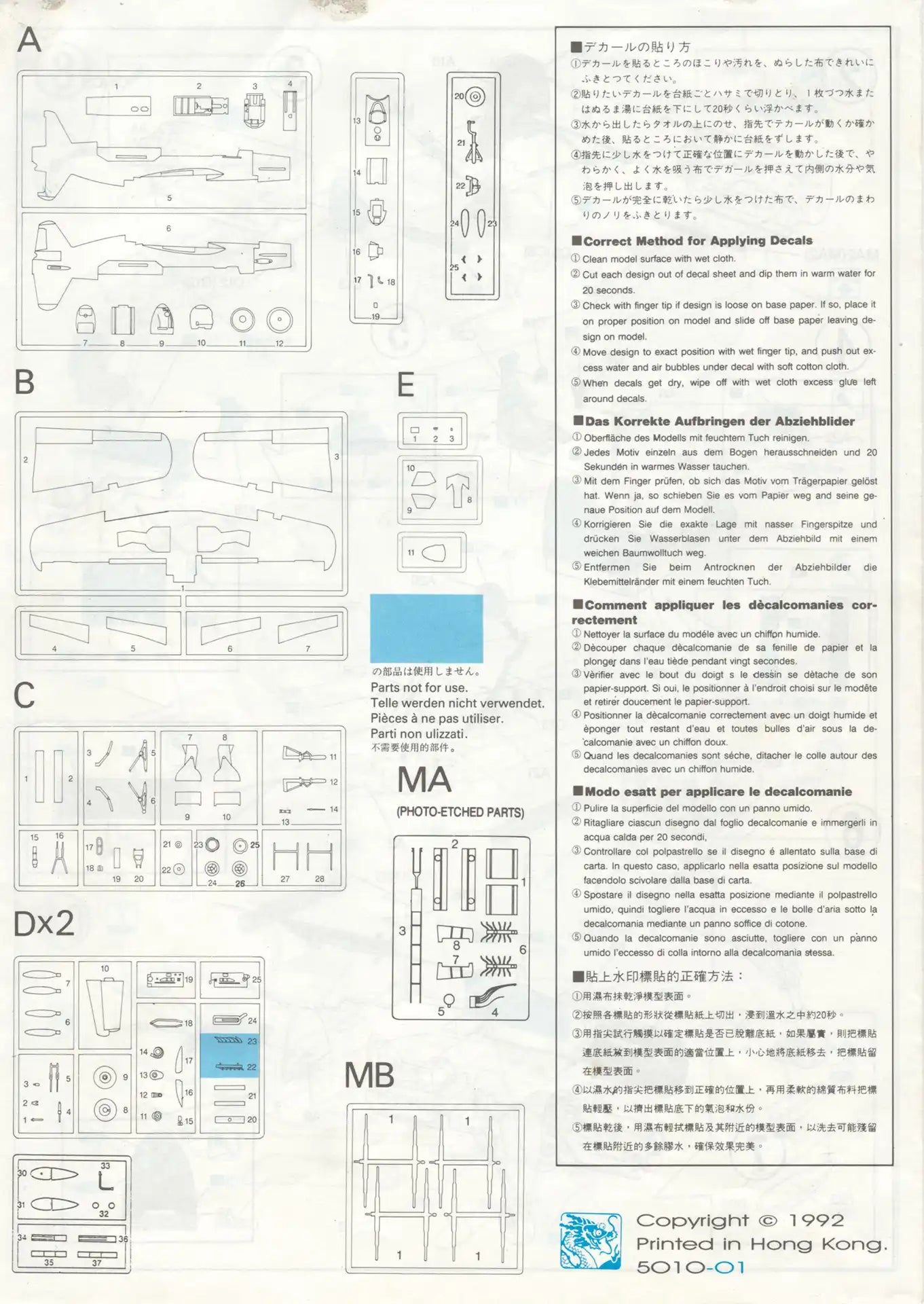
- Plastic parts, clear parts, assembly guide, photo-etch, decals, box
- Parts Count:
- 160 pieces
- Marking Options:
- 1
- Operator Nations:
- Germany
- Era:
- World War II (1939–1945)
- Skill Level:
- 4/5 Proficient