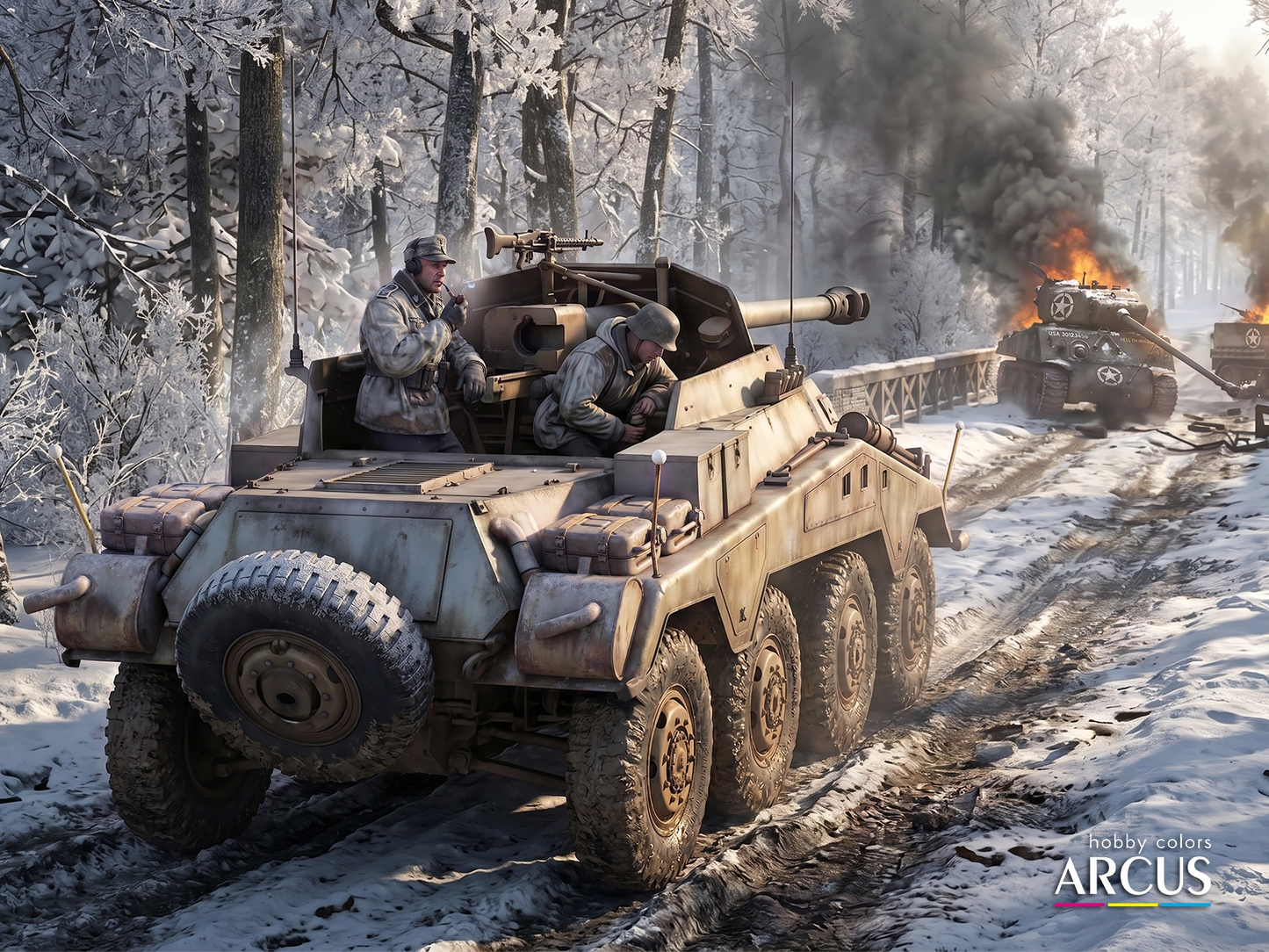
Arcus E2095 Wehrmacht: Watch on the Rhine


Wehrmacht: Watch on the Rhine
The German counteroffensive in the Ardennes during the winter of 1944–1945, designated Unternehmen Wacht am Rhein (Operation Watch on the Rhine), stood as one of the Wehrmacht's most successful operations in the closing stages of World War II. The German High Command made a desperate gamble: to cleave through the Allied lines, capture Antwerp, and force the Western powers into a separate peace. Strict operational secrecy and dense winter fog, which grounded Allied airpower, allowed them to achieve complete tactical surprise.
In the opening days, massive Panzer spearheads swiftly shattered American defenses. To sow panic, German commandos disguised in US uniforms infiltrated the Allied rear to sabotage logistics and redirect road signs. However, the grand operational design soon collided with a harsh reality—the advancing units were critically short on fuel. The offensive's momentum stalled at key crossroads, notably around Bastogne, where the Americans mounted a fierce defense, denying the Germans access to the fuel depots necessary for any further advance.
During this period, Wehrmacht armor typically carried a standard sand-yellow base coat (RAL 7028 Dunkelgelb), over which irregular patches of brown and green—RAL 8017 Rotbraun and RAL 6003 Olivgrün, respectively—could be applied. As the war drew to a close, some vehicle components were left completely unpainted, remaining only in their factory red primer (RAL 8012 Rotbraun).
As soon as the weather cleared, Allied aviation reestablished air supremacy. Relentless bombing decimated the overextended German supply columns, decisively halting the armor. This massive battle consumed Germany's last operational reserves in the West. Ultimately, despite the rapid initial success of the German forces, the end of the Third Reich was inevitable.
Suggested kits:
Flakpanzer 38(t) (Sd.Kfz. 140), Flakpanzer IV "Möbelwagen" (Sd.Kfz. 161/3), Flakpanzer IV "Ostwind" (Sd.Kfz. 161/3), Flakpanzer IV "Wirbelwind" (Sd.Kfz. 161/4), Jagdpanzer 38(t) "Hetzer" (Sd.Kfz. 138/2), Jagdpanzer IV (Sd.Kfz. 162), Jagdpanther (Sd.Kfz. 173), Jagdtiger (Sd.Kfz. 186), Panzerjäger Tiger (P) "Ferdinand / Elefant" (Sd.Kfz. 184), Panzerjäger "Marder II" (Sd.Kfz. 131), Panzerjäger "Marder III" (Sd.Kfz. 138 / 139), Pz.Kpfw. VII "Löwe", Pz.Kpfw. VIII "Maus" (Sd.Kfz. 205), Pz.Kpfw. II Ausf. L "Luchs" (Sd.Kfz. 123), Pz.Kpfw. III (Sd.Kfz. 141), Panzerjäger III/IV "Nashorn" (Sd.Kfz. 164), Panzerwerfer 42 (Sd.Kfz. 4/1), Pz.Kpfw. VI Ausf. E "Tiger I" (Sd.Kfz. 181), Pz.Kpfw. VI Ausf. B "Tiger II / Königstiger" (Sd.Kfz. 182), Geschützwagen 38(t) "Grille" (Sd.Kfz. 138/1), Geschützwagen III/IV "Hummel" (Sd.Kfz. 165), Sd.Kfz. 7, Sd.Kfz. 9 "FAMO", Sd.Kfz. 11, Geschützwagen II "Wespe" (Sd.Kfz. 124), Sd.Kfz. 221, Sd.Kfz. 222, Sd.Kfz. 231, Sd.Kfz. 232, Sd.Kfz. 234, Sd.Kfz. 247, Sd.Kfz. 250, Sd.Kfz. 251, Schwerer Panzerspähwagen (8-Rad) (Sd.Kfz. 263), StuG III (Sd.Kfz. 142 / 142/1), Sturmpanzer IV "Brummbär" (Sd.Kfz. 166), Sturmmörser "Sturmtiger", etc.
- Product type:
- Paint Set
- Condition:
- New
- Manufacturer:
- Arcus
- Product code:
- E2095, A2095
- Country of Origin:
- Ukraine
- Volume:
- 6 × 0.33 fl oz (10 mL)
- Finish:
- Semigloss
- Paint Type:
- Enamel, acrylic
- Package Contents:
- Paint bottles (6 pcs.), box
- Operator Nations:
- Germany
- Era:
- World War II (1939–1945)